
If you’ve been following the tech world lately, you know that Artificial Intelligence isn't just a buzzword anymore: it’s the engine running under the hood of most modern businesses. But here’s the reality: as we rush to plug AI into every part of our operations, we’re leaving the windows wide open for some very fast-moving intruders.
Earlier this week, the cybersecurity community was hit with a wake-up call that should make every business owner pause. A critical vulnerability in Langflow (tracked as CVE-2026-33017) was disclosed. For those not in the weeds of AI development, Langflow is a popular open-source framework used to build and deploy AI agents. It’s a great tool, but this specific bug allowed for "unauthenticated Remote Code Execution" (RCE).
In plain English? It meant anyone on the internet could walk into your AI system, take control of the server, and do whatever they wanted: no password required.
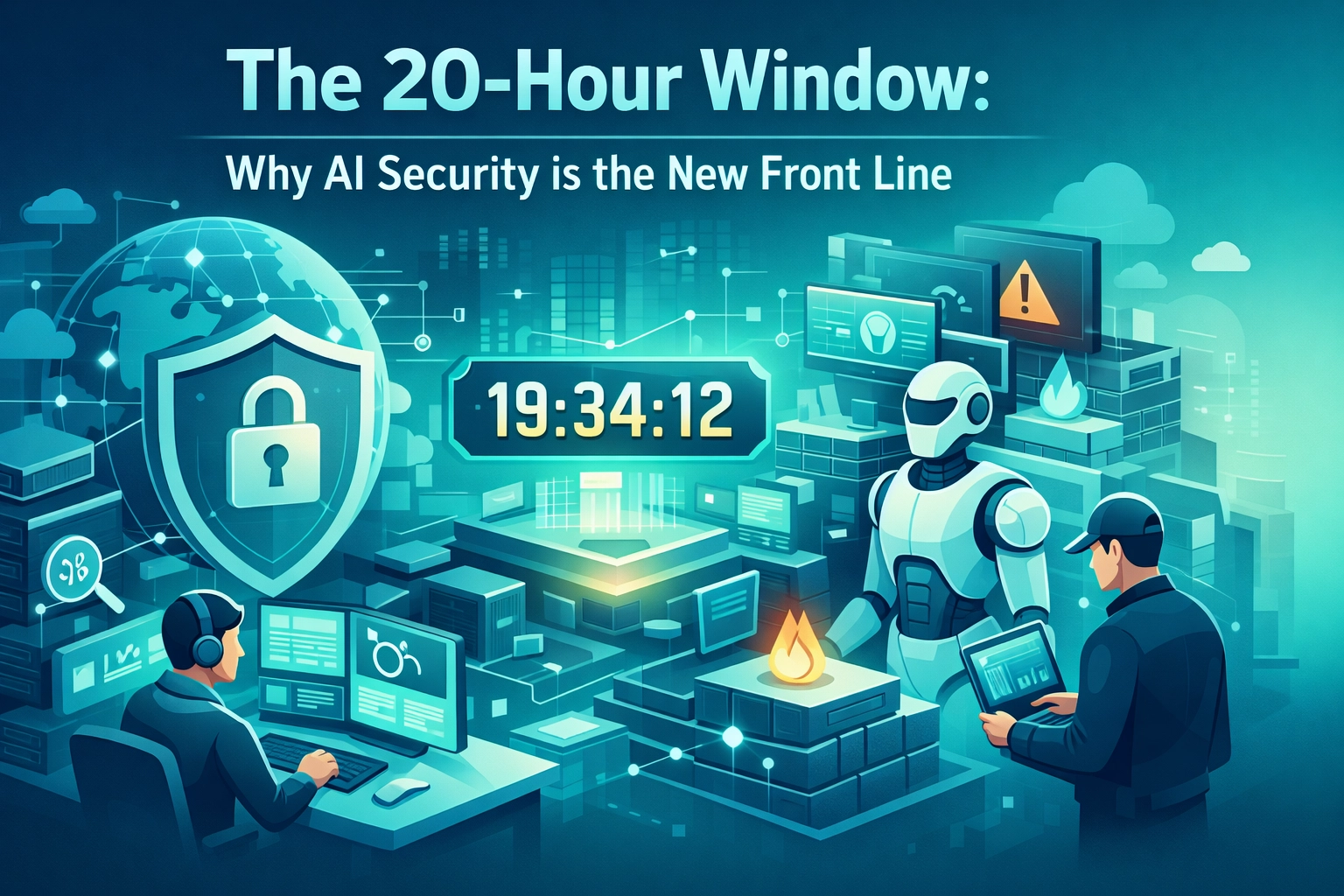
But the real story isn't just the bug itself. It’s the clock. Active attacks on this vulnerability were spotted just 20 hours after the details went public.
At B&R Computers, we’ve seen the "time-to-exploit" window shrinking for years, but we’ve officially entered the era where "business hours" don't exist in the eyes of a hacker. If you aren't protected in less than a day, you're already behind.
The Collapse of the "Grace Period"
Not too long ago, when a software bug was found, IT teams usually had a "grace period." You’d have a few weeks, maybe even a month, to test a patch and roll it out before hackers figured out how to use that bug against you.

That window has officially collapsed. In 2020, it might have taken a month for a hacker to go from finding a way in to actually deploying ransomware. By 2024, that was down to five or six days. Today, in 2026, we are looking at a "Time-to-Exploit" measured in mere hours.
Why the sudden speed? Because hackers are using the same AI tools we are. They’ve automated the process of scanning the entire internet for vulnerable systems. When a new CVE (Common Vulnerabilities and Exposures) is announced, an AI-driven botnet can find every vulnerable server on the planet before the coffee in your breakroom is even cold.
As we've seen in recent research, AI-powered simulations can now compromise a system from initial access to full data theft in about 25 minutes. When the attackers are moving at machine speed, a human-paced response just won't cut it.
Why Langflow Was the "Total Keys to the Kingdom"
To understand why the Langflow exploit was so dangerous, you have to understand what an AI framework actually does. Langflow helps businesses connect their AI models to their real-world data: their customer databases, their internal documents, and their proprietary APIs.
When you have an RCE vulnerability in a tool like Langflow, you aren't just losing a password or a single file. You are giving the attacker access to the "brain" of your business operations. Since the AI is already "authenticated" to look at your sensitive data so it can answer questions, the hacker who hijacks that AI inherits all those permissions.
It’s the ultimate "keys to the kingdom" scenario. If an attacker can run code on your AI server, they can:
- Siphon off every customer record the AI has access to.
- Inject malicious instructions into the AI so it gives your team (or customers) false information.
- Use your server's computing power to launch attacks on other businesses, leaving your name on the digital fingerprints.
This is why cybersecurity in the age of AI requires a much more aggressive stance than traditional IT management.
The Risks of "Open Source" Without a Plan
We love open-source software. It drives innovation and lets small businesses compete with the giants. However, the Langflow incident highlights a growing trend: businesses are adopting open-source AI frameworks at a record pace without applying a security-first approach.
Developers often prioritize "getting it to work" over "making it secure." They pull down a framework, connect it to the company’s most sensitive data, and leave the default settings active. In many cases, these AI tools are deployed outside the traditional oversight of the IT department: something we call "Shadow AI."
If your team is building AI agents using open-source tools, you need to ask three questions:
- Is this tool exposed to the public internet?
- Does it require authentication for every action?
- Are we monitoring the logs for unusual activity in real-time?
At B&R, our AI consulting services focus on exactly this. We help you harness the power of AI without creating a back door for the rest of the world to walk through.

Why AI is the New Favorite Target
Hackers are smart. They follow the money and the data. Right now, the most valuable data in any organization is being fed into AI models to help with decision-making, marketing, and customer service.
AI systems are "data-dense." Instead of a hacker having to hunt through thousands of different folders on a server, they can just ask the AI to "summarize the last ten years of financial records" or "list all customers with high net worth." By targeting the AI, they let your own technology do the heavy lifting of data theft for them.
Furthermore, AI systems often run on high-powered hardware (GPUs) that are incredibly expensive. Hackers love to hijack these systems not just for data, but for "crypto-jacking": using your expensive hardware to mine digital currency on your dime.
How to Defend Your Business in a 20-Hour World
If the window to respond is only 20 hours, you can't rely on manual checks once a week. You need a proactive strategy. Here is how we recommend businesses handle the "Time-to-Exploit" collapse:
- Automated Vulnerability Scanning: You need systems that are constantly looking for new "holes" in your digital fence. When CVE-2026-33017 dropped, our managed clients were already being scanned for exposure before the news even hit the mainstream tech blogs.
- Zero Trust Architecture: Never assume a user (or an AI agent) is friendly. Every request should be authenticated. If Langflow had been behind a proper Zero Trust barrier, the "unauthenticated" part of the exploit wouldn't have mattered.
- AI-Driven Defense: To beat an AI, you need an AI. We use advanced cybersecurity tools that detect "anomalous behavior." If your AI suddenly starts trying to access a database it doesn't need, our systems shut it down in milliseconds: long before a human could even open the alert email.
- Regular Audits: Don't wait for a breach to find out where you're vulnerable. Check out our DIY Cybersecurity Audit checklist for a starting point, but remember that AI adds a layer of complexity that often requires professional eyes.

The B&R Perspective: Stay Fast, Stay Safe
The Langflow vulnerability is a milestone. It’s a sign that the "honeymoon phase" of AI is over and the "security phase" has begun. We want you to use these incredible tools. We want your business to be faster, smarter, and more efficient because of AI. But we don't want you to be a headline.
The 20-hour window is the new reality. It means your security can't be a project you tackle "when you have time." It has to be the foundation of everything you build.
If you’re worried about how your AI tools are set up, or if you’re not sure if your current managed IT services are moving fast enough to catch a 20-hour exploit, let’s have a conversation. We’ve been keeping businesses safe in the Hudson Valley and beyond for years, and we’re ready to help you navigate this new front line.
Don't Wait for the Next 20-Hour Clock to Start
The best time to secure your AI was yesterday. The second best time is right now. Don't let your business be the next "easy target" for an automated attack.
Take Action Today:
- Ready for a deep dive? Book a BRC Cyber Strategy Session with our team to evaluate your current risks.
- Want to level up your team's knowledge? Download our SMB Cyber Playbook for a clear, no-nonsense guide to protecting your business.
- Not sure where you stand? Contact us today to learn more about our AI-driven security solutions.