
Shadow AI: Why Your Team’s Secret ChatGPT Habit is a Security Gap
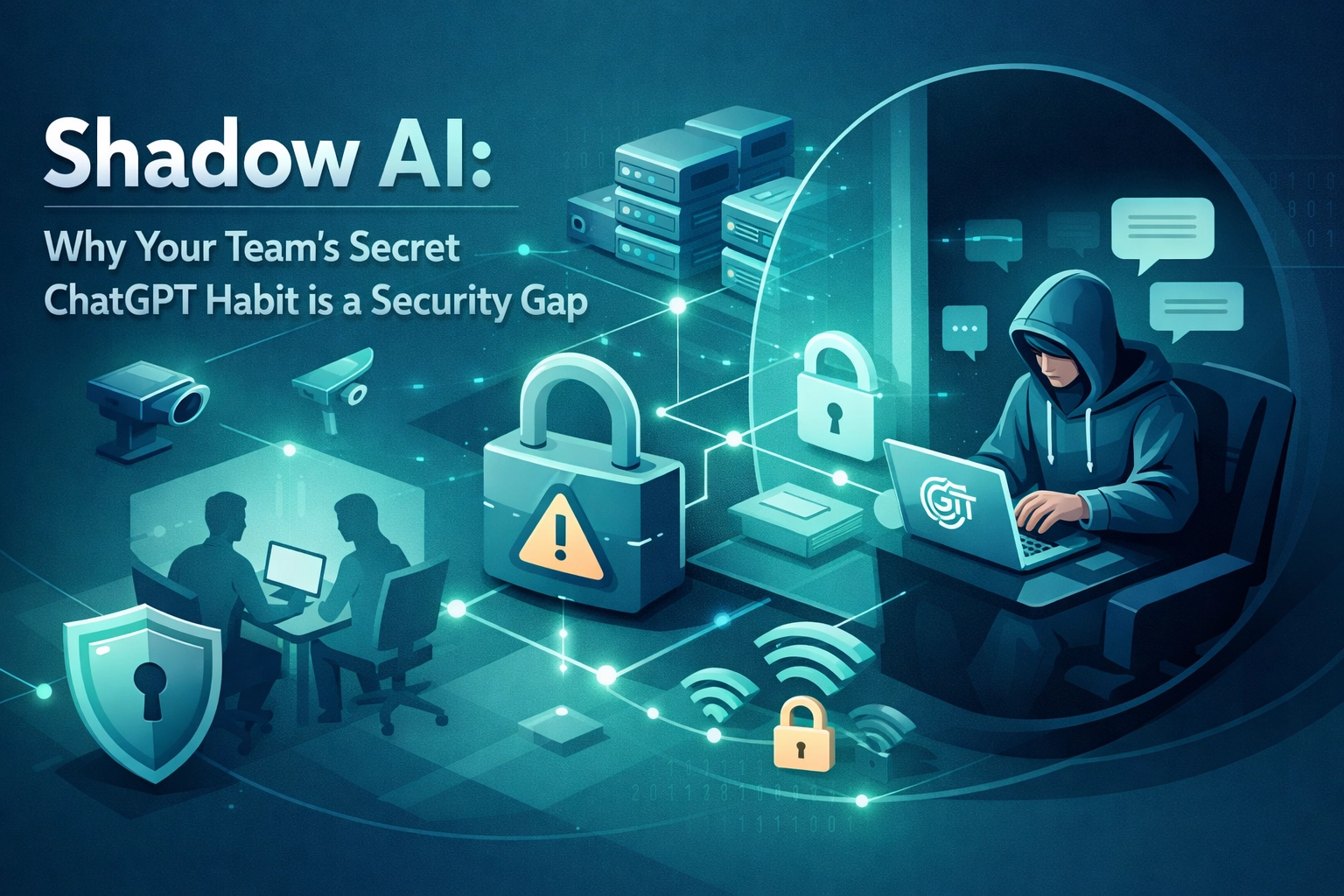
Let’s be honest: your employees are using AI. Even if you haven't cut a check for an Enterprise ChatGPT license or officially integrated Gemini into your workflow, someone in marketing is using it to draft emails, and a developer is definitely using it to debug code.
At B&R Computers, we call this Shadow AI. It’s the use of artificial intelligence tools within an organization without the explicit approval or oversight of the IT or security department. It’s the modern version of "Shadow IT", those days when people would download Dropbox or Trello on their work computers because the company-approved tools were too clunky.
But Shadow AI is a different beast entirely. It’s not just about where a file is stored; it’s about the sensitive data being fed into a "black box" that learns from everything it touches. If you don't have a handle on how your team is using AI, you don't just have a productivity trend, you have a massive security gap.
The Invisible Surge: AI by the Numbers
If you think your team is the exception, the data suggests otherwise. Recent studies show that a staggering 80% of workers are using AI tools at work without IT approval. Perhaps even more concerning is that 34% of those users are relying on free or non-approved versions of these tools.
Why does that matter? Because free versions of generative AI tools often use the data you input to train their future models. If an employee pastes a confidential client contract or a proprietary algorithm into a free AI to "summarize" or "clean it up," that data is now part of the provider's training set. It’s out of your control, permanently.
The financial stakes are just as high. Data shows that Shadow AI breaches cost $670,000 more on average than breaches where AI use was sanctioned and governed. When a breach happens through an unmanaged tool, discovery takes longer, containment is harder, and the forensic trail is often non-existent.

The 2025 Credential Crisis
We’ve seen a massive shift in how hackers target businesses over the last year. In 2025, IBM reported a shocking statistic: over 300,000 ChatGPT credentials were compromised.
This wasn't because OpenAI was hacked. It was because employees were logging into their "secret" AI accounts on infected personal devices or using weak passwords that were easily harvested by infostealers. Because these accounts sit outside the company’s managed IT services umbrella, they often lack Multi-Factor Authentication (MFA) or Single Sign-On (SSO) protections.
We’ve talked before about how infostealers are the silent epidemic draining small business bank accounts, and Shadow AI is currently their favorite entry point. When a hacker gets into an employee's ChatGPT account, they don't just get a chat history, they get a goldmine of every sensitive document, piece of code, and internal strategy the employee has "shared" with the bot to get their work done faster.
Why Your Team is Hiding Their AI Use
At B&R Computers, we don’t believe in blaming employees. People use Shadow AI because they want to be better at their jobs. They want to work faster, automate the boring stuff, and meet deadlines that feel impossible.
The problem is the "Security-Productivity Gap." If the official process for getting an AI tool approved takes six months of committee meetings, a high-performer is going to find a workaround in six seconds.
The "B&R Way" isn't about blocking these tools and playing digital whack-a-mole. That just drives the behavior further underground. Instead, we focus on empowerment through knowledge and governance. We want to help you say "Yes, and here is how we do it safely," rather than a flat "No" that everyone ignores anyway.
The Hidden Risks: Beyond Just Data Leaks
While data leakage is the most talked-about risk, Shadow AI creates several other "blind spots" for your business:
- Compliance Chaos: With 21 states having recently changed their data privacy laws, your business is likely under stricter scrutiny than ever. If an employee puts PII (Personally Identifiable Information) into an unsanctioned AI, you are technically in violation of these laws, whether you knew about the tool or not.
- Lack of Auditability: If a customer asks how a specific decision was made, and that decision was generated by an unmanaged AI, you can't provide an audit trail.
- The "Hallucination" Liability: Unmanaged AI use means unvetted output. If an employee uses an AI to draft legal advice or technical specifications without oversight, and the AI "hallucinates" a fact that leads to a lawsuit, your business is on the hook.

Building an AI Governance Strategy: The B&R Approach
So, how do you close the gap? It starts with moving from a "detect and block" mindset to an "identify and govern" strategy. Here is how we recommend our clients approach AI governance:
1. Conduct an AI Risk Assessment
You can't manage what you can't see. We help businesses look at their network traffic to identify which AI domains are being accessed and by whom. This isn't about a "gotcha" moment; it's about understanding the business need. If 40% of your team is using a specific AI tool, there’s a clear demand that the company should probably address with a secure, enterprise-grade version.
2. Implement "AI-Ready" Hardening
Before you lean into AI, your basic security house needs to be in order. We often see businesses chasing the latest AI shiny object while ignoring the basics. As us about our 10 easy wins for cybersecurity hardening to ensure that even if an AI credential is stolen, the rest of your network remains a fortress.
3. Establish Clear Policies
Your team needs to know what is okay and what isn't. A simple AI policy should cover:
- Which tools are approved.
- What kind of data can never be uploaded (e.g., client lists, source code, financial records).
- The requirement for human-in-the-loop review of all AI-generated content.
4. Provide Secure Alternatives
The best way to stop Shadow AI is to provide "Sanctioned AI." This means setting up enterprise versions of tools like ChatGPT Team or Microsoft 365 Copilot, where the provider guarantees that your data will not be used to train their models and where SSO and MFA are enforced.

Proactive Strategies for a Smarter Workforce
The goal isn't to stop the future; it's to survive it. At B&R Computers, we offer AI consulting to help small and medium businesses navigate this shift. We don't just look at the tech: we look at the workflow.
Shadow AI is a symptom of a team trying to innovate. By bringing that innovation out of the shadows, you protect your data, stay compliant, and actually get the ROI you were hoping for from AI in the first place.
If you're worried that your team has a "secret" ChatGPT habit, they probably do. But instead of reaching for the "block" button, reach out to a partner who can help you build a framework that keeps your business fast and safe.
Don't let your proprietary data become part of a public training set. Let’s get your AI governance on track before a "secret habit" turns into a very public headline.
Ready to see where your gaps are? Contact B&R Computers today for an AI Risk Assessment or download our SMB Cyber Playbook to start hardening your defenses against the threats of 2026.